



What is competitive intelligence?
Competitive intelligence refers to the practice of collecting and analyzing data on your competitors and delivering insights gleaned from that data to stakeholders around the business.
Good competitive intelligence work combines information learned about competitors with customer research to make sure insights align with what a business’ target market really wants. Combined, they inform a competitive strategy aimed at winning greater market share and winning more deals.
Competitive intelligence vs. competitor analysis vs. market intelligence vs. business intelligence
These four terms get used interchangeably more often than they should. They're related, but they're not the same discipline, and mixing them up tends to show up later as the wrong team owning the wrong piece of work.
Competitive intelligence
Competitive intelligence is the broadest of the four. It covers the entire external business environment: competitors, yes, but also customers, distributors, technology shifts, and macroeconomic data. The goal is making the whole organization more competitive, not just building a file on your rivals.
Competitor analysis
Competitor analysis is a piece of competitive intelligence, not a stand-in for it. It's the act of studying specific, named competitors: their pricing, their positioning, their strengths and weaknesses. Where CI takes in the whole environment, competitor analysis zooms in on the players you're up against directly.
Market intelligence
Market intelligence is a subtype of CI focused on the marketing mix: pricing, place, promotion, and product. It moves faster than most CI work, often measured in days or weeks rather than quarters, and it's used mainly by marketing and sales teams responding to what's happening in the market right now.
Business intelligence
Business intelligence looks inward. Where CI is outward-facing, BI analyzes your own company's operations, sales figures, and systems to improve efficiency. The two disciplines feed each other, since BI often absorbs the findings CI brings back, but they answer different questions and usually sit with different teams.
Why is competitive intelligence important?
You learn what your customers want
At the heart of any competitive intelligence program, you’ll find a motivation to understand the customer. You have to understand what the market wants before you can provide it.
But speaking to prospective customers only gets you so far. Especially if you’re a step behind and losing customers to competitors.
Competitive analysis is about learning why customers go elsewhere and finding out why you lose.
Market research that helps you better understand your competitors, what they offer, and what customers like about what they offer, puts you in a better position to win competitive deals.
Some of what you find might surprise you, too. It’s not uncommon to hear your customers claim you don’t offer a feature that has actually been a part of your offering for some time.
Not communicating to your customers that your product meets their needs is the same as not meeting those needs at all.
It teaches you your competitors’ strengths and weaknesses
No one can be good at everything.
Even if you’re up against established giants with huge budgets, there are ways to play your position as the small upstart to your advantage. After all, who doesn’t love an underdog?
Without intel on your competitors, though, you’ll never uncover their strengths and weaknesses. Knowing where your competitors are weak gives you a chance to position yourself as the answer to their shortcomings. Knowing where they’re strong shows you ahead of time which fights you can’t win, where it’s sensible to conserve your energy, and where it’s worth making a stand.
Pretty useful, right?
Put another way, market intelligence gives you a clear view of the competitive landscape. And a clear view of the competitive landscape makes it obvious where your products should sit within it.
That means better positioning, a more persuasive offering for customers, and an increase in revenue.
“... understanding what competitors are helping other customers do can help you figure out whether or not you’re going to play against them in the market.”
Clint Buechler, Associate Manager of Growth Marketing at Rhino.
You’ll gain a deeper understanding of buyer motivations
Numbers don’t lie. And neither do customers…
At least, that’s what we’d like to believe. But some prospects don’t have a deep enough understanding of their own motivations to give you truthful answers. And if the data you get from customer interviews doesn’t reflect reality, it won’t get you results.
That’s where competitive intelligence comes in. Including information on your competitors gives you a more complete picture of your prospects’ motivations. And the more sources of data you have, the less power a few outliers have to skew the entire dataset.
This’ll give you peace of mind next time you’re worrying about the accuracy of the answers from your customer surveys.
CI also offers objectivity.
It helps you offset biases in your organization about your products. Seeing yourself from the market’s perspective lets you objectively identify what needs to change about your brand for you to win more business. Be it your product positioning, your messaging, or your content marketing strategy.
Uncover new market trends and opportunities
The modern marketplace is dynamic, disruptive, and fast-moving. It’s impossible to compete if you’re a step behind. When you’re gathering competitive intelligence day in and day out, though, it’s impossible not to keep up to speed with the latest goings-on.
When you’ve got an active, successful competitive intelligence program, you’re in a great position to spot new industry trends and opportunities as they emerge.
You might notice your target audience migrating to products with a common feature. If your product doesn’t have this feature yet, you can act swiftly to make developing that feature a priority.
CI helps you anticipate your competitors’ next moves
Just as CI helps uncover emerging market trends and opportunities, it also alerts you to emerging threats. Having your finger on the pulse of the market makes it possible to anticipate your competitors’ next moves.
When you’re one step ahead, and you capitalize on your competitor’s weaknesses, you’ll neutralize competitor strategies as fast as they can devise them.
Of course, you can’t predict everything. But this will help you get and stay ahead of the competition when new products and services catch your customers’ eyes.
You can build a sustained competitive advantage
When you have a competitive advantage, you’re well-positioned to win more customers than your competitors. But your edge in any highly competitive endeavor is small. And your competitors will be working around the clock to replicate your advantage and diminish your lead.
So how do you make your advantage sustainable?
It starts with data collection. Collecting information on your competitors helps you establish a baseline of behavior. If they move away from this baseline, you’ll know they’re up to something.
These behavioral shifts can act as early warning signals, alerting you before competitors make a move on your advantage.
But since CI uncovers opportunities too, it can show you where your competitors’ advantages lie.
This can inform strategic decisions around new advantages and possibilities that your competitors haven’t yet exploited, or have left undefended. Make these advantages your own and you’ll acquire more market share and increase your brand’s longevity.
CI helps you prioritize, with a huge impact on revenue
There’s an infinite amount of work in all organizations. You’ll never be able to do it all. Such time constraints make prioritization crucial.
CI helps here too. It helps you prioritize and make more informed business decisions.
It teaches you what your customers value most, and helps you filter out the competitive battles you stand no chance of winning. You’re left with (i) the areas you’re already knocking it out of the park, and (ii) the areas where a strategic tweak or two can have landslide consequences for your bottom line. For better or worse.
These areas are like swing states. A few votes in either direction could decide the entire election. That is, the vote the customer casts with their dollars and cents.
In competitive deals, just a few persuasive points in your favor could mean thousands more prospects choosing you over a competitor. Even if it’s a close-run thing, they can only pick one.
So, depending on your average deal size, these are massively leveraged opportunities to impact your organization’s bottom line.
Competitive intel helps you strengthen strategies across the business
A great CI strategy will go on to inform a ton of other strategies across the business.
From your product positioning strategy to your content marketing strategy, even your pricing and brand messaging. You can improve them all when your competitive intelligence program gets underway.
The end result of all this? A stronger product, a better customer experience, more won deals, and increased revenue. All thanks to competitive intelligence.
How it works: the competitive intelligence cycle explained
Competitive intelligence is not a one-and-done task. It’s not even really a series of steps.
No, competitive intelligence is best explained as a cycle. New intel on your competitors pops up all the time. It’s your job to capture it, analyze it, and figure out what it means for your business. From there, you’ll deliver those insights in the format best suited for the internal customers (stakeholders) you’re serving.
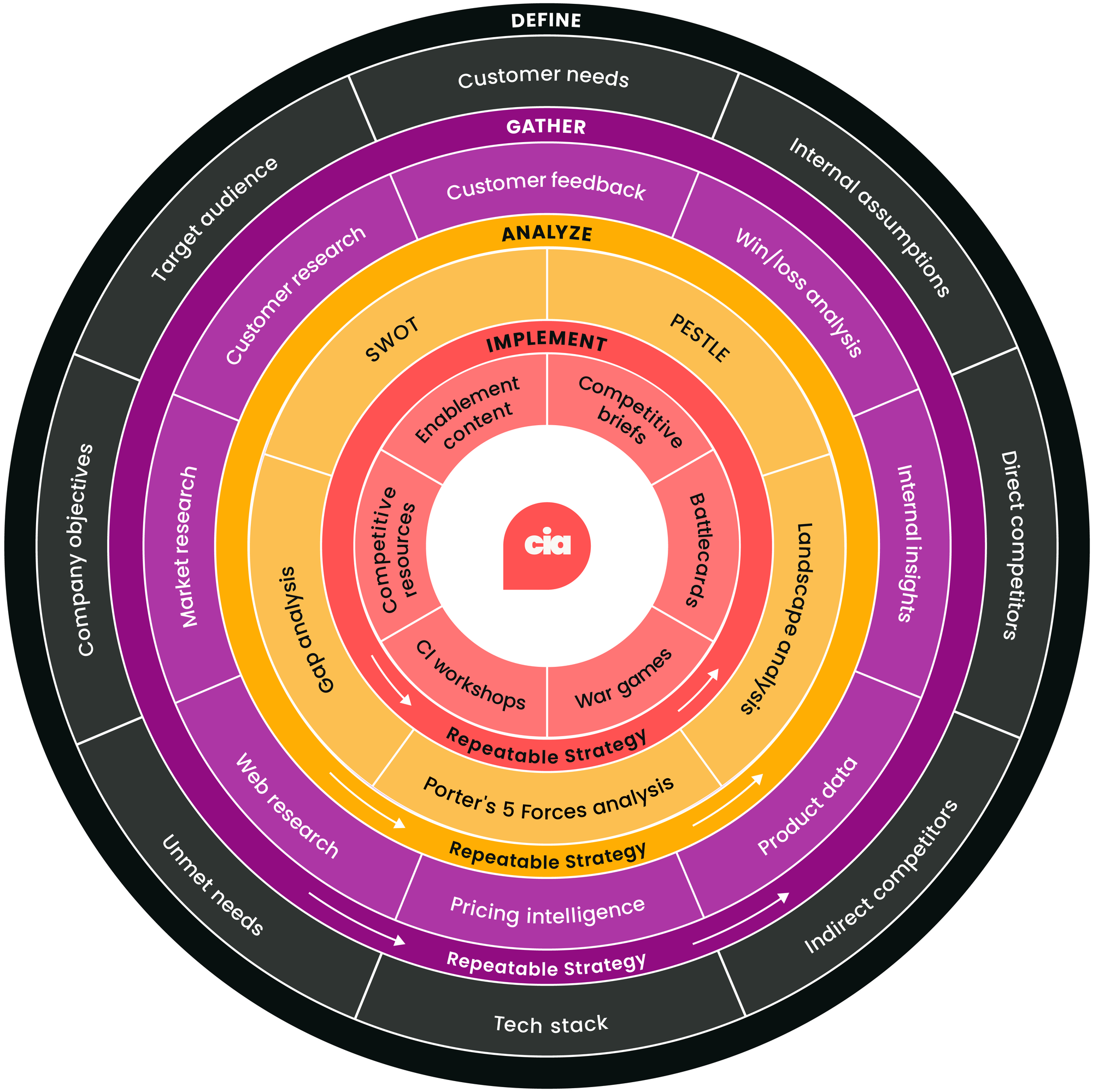
The stages of the cycle are, perhaps, best outlined like this:
1. Orientation: sync with the needs of the business: leadership goals, stakeholder needs, and what “done” looks like for this round of intelligence. You don't have to repeat this every cycle, but revisiting it periodically keeps your output relevant.
2. Data gathering: collect the raw intelligence: competitor moves, customer feedback, market signals, and internal insights, using the sources and methods that fit your objective.
3. Data analysis and processing: interpret what you've gathered in light of what you already know, and start shaping it into a point of view rather than a pile of facts.
4. Data reporting: distill your analysis into the format your stakeholders actually need: a battlecard, a brief, a slide, a dashboard.
5. Actioning: track whether stakeholders use what you've given them. A great brief nobody opens hasn't moved the needle, so tie adoption back to outcomes, like win rates, wherever you can.
Looking for more information on the CI cycle? Here’s the competitive intelligence cycle explained in 5 steps .
How to set up a CI process
Starting a CI function from nothing is a different problem from running the cycle once you already have one. Here's a practical starting sequence:
1. Define your objectives. Get specific about what decisions this intelligence needs to support: pricing, product roadmap, sales enablement, or something else. Vague objectives produce vague intelligence.
2. Identify your stakeholders. Work out who actually needs this intelligence and what they'll do with it: sales, product, leadership, marketing. Their needs shape what you gather and how you report it.
3. Map your competitors and sources. Decide which competitors matter most right now, and which sources (websites, CRM, win/loss interviews, social media) will actually get you there.
4. Allocate resources. Decide who owns this work, how much time it gets, and whether you need tooling to make it sustainable. CI that depends on one person's spare hours rarely survives a busy quarter.
5. Build your reporting cadence. Agree on how often intelligence gets delivered, and in what format, before you start gathering. A weekly digest and a quarterly executive briefing serve very different purposes.
6. Review and refine. Revisit your sources, stakeholders, and objectives on a regular cycle. A CI process that doesn't evolve with the market it's tracking will quietly go stale.
Types of CI
There are both multiple types of competitive intelligence work, and multiple types of competitive intelligence data.
First, we’ll discuss the various types of competitive intelligence work you can do.
Types of competitive intelligence work: strategic vs. tactical
There are two main types of competitive intelligence work: tactical and strategic.
Tactical
Tactical CI work is more short-term, and more reactive, than strategic CI. It’s about what’s happening right now, what has happened recently, and what you should do about it as a business.
Usually, tactical competitive intelligence work’s aims can be described as “quick wins”. How can we enable sales to win more deals – today? Can we tweak our pricing to persuade more prospective buyers – today? A competitor just released a new feature, what must we do to remain competitive – today?
Strategic
Strategic competitive intelligence work, by contrast, concerns itself with longer-term business objectives.
It’s focused on broader market and industry trends, and it looks to advise overarching business strategy. Such advice steers a business toward capitalizing on market opportunities, sidestepping threats in the competitive landscape, and thriving into the future with a sustained competitive advantage.
Market intelligence, changing consumer behavior, and longer-term signs from competitors about the shifting landscape, become much more important in this kind of CI work, and those performing it are likely to report directly to leadership.
CI-by-Industry eBook
Download your copy to learn...
- 😰 Why field intelligence can be dangerous, and how to use it the right way. (Page 24)
- 🙅♂️ Why you should think twice before having reps from this team on a win/loss call. (Page 24)
- 🤖 The truth about automation, and how much time tools can really save you. (Page 22)
- 🤯 The surprising key skill every one of our industry experts said was crucial for CI success. (Page 66)
Types of competitive intelligence data: internal vs. external
The types of competitive intel you can collect and work with can be broadly separated into two categories: internal and external.
Internal data
Internal data is just external data someone else in your business has already collected. Since the work has already been done, it’s most practical to find this information within the business. For this reason, it’s referred to as internal data.
What’s more, it benefits you to actively encourage people to collect as much data as they can on your behalf. Competitive intelligence teams are usually small (when there’s more than one person dedicated to the role at all). Resources are, therefore, limited.
The experts we’ve spoken to consider it a best practice to “crowdsource” your competitive intelligence efforts, building a “culture of compete” where everyone considers it a shared responsibility to keep an eye on competitors, and report intel back.
Here’s a list of the places inside the business where you can find intel:
- Your CRM.
- Your sales and customer success reps.
- Your leadership team.
External data
External data can be further categorized.
These subcategories are best considered through the means of acquiring them. There is necessarily some overlap between types of external data. In the next section, we’ll examine these methods in detail.
They include:
- Customer research data.
- Win/loss data.
- Competitor announcements.
- Wider market and industry intelligence.
- Information about a competitor’s various strategies (content, PPC, marketing, positioning, etc).
The history of competitive intelligence
Competitive intelligence has a defined starting point, and it's earlier than most people assume.
1980: Harvard's Michael Porter published Competitive Strategy: Techniques for Analyzing Industries and Competitors. It's widely regarded as the foundation of modern competitive intelligence, laying out the analytical tools for evaluating competitors that the field still leans on today.
1985: Leonard Fuld published a bestselling book dedicated specifically to competitor intelligence, turning it into its own branch of business strategy rather than a subset of general strategic planning.
1986: The Society of Competitive Intelligence Professionals (SCIP) was founded, giving the field its first dedicated professional association and, eventually, a formal code of ethics.
1988: Ben and Tamar Gilad published the first organizational model for a formal corporate CI function. US companies adopted it widely, and it's generally seen as the point CI became an institutionalized activity inside corporations, rather than something a few research-minded employees did on the side.
Nearly 40 years on, the fundamentals haven't moved much. What's changed is the volume of publicly available data, and the tools available to make sense of it.
Competitive intelligence ethics: legal vs. illegal
Competitive intelligence and industrial espionage can look similar from a distance. They aren't the same thing, and the line between them has cost real companies real money.
What makes CI legal and ethical
Legitimate CI relies on publicly available information, or information gathered through honest inquiry: a competitor's website, their pricing pages, regulatory filings, job postings, trade shows, and interviews where you disclose who you are and why you're asking. SCIP, the profession's main association, maintains a code of ethics that CI professionals are expected to follow. Its core points:
- Continually strive to increase the recognition and respect of the profession.
- Comply with all applicable laws, domestic and international.
- Accurately disclose your identity and organization before all interviews.
- Avoid conflicts of interest in fulfilling your duties.
- Provide honest and realistic recommendations and conclusions.
- Promote this code of ethics within your company and with third-party contractors.
- Faithfully adhere to your own company's policies, objectives, and guidelines.
Where it tips into illegal
Industrial espionage starts where deception, theft, or unauthorized access replace those methods: misrepresenting who you work for, hacking a competitor's systems, or obtaining private records under false pretenses. A few real cases show how expensive that line is to cross.
Oracle (2000): Oracle hired a detective agency to investigate two research groups defending Microsoft during its antitrust trial. The agency found the groups were misrepresenting themselves as independent when they were actually funded by Microsoft. Oracle's chairman later stood by the outcome, even while acknowledging the methods used to get there were questionable.
WestJet vs. Air Canada (2004–2006): WestJet accessed Air Canada's internal, password-protected employee website more than 243,000 times over 10 months, and used what it found to adjust its own routes and schedules. Air Canada sued. WestJet issued a public apology, called its own actions unethical, and paid out $15.5 million in Air Canada's legal fees plus $10 million to charity. A company co-founder resigned over it.
HP (2006): HP's board hired private investigators to trace a boardroom leak to the press. Those investigators used pretexting, misrepresenting themselves to phone companies, to access the private call records of HP directors and journalists. California's Attorney General settled the resulting case for $14.5 million.
None of these three started out as illegal operations. Each one crossed the line the moment it swapped a legitimate method for a deceptive one.
Best competitive intel gathering methods and sources
Here’s a list of data gathering methods you’ll want to become familiar with:
- Win/loss interviews
- Customer research
- Competitor websites
- Competitor help and support documentation
- Competitive SEO analysis
- Social media
- Community forums
- Press releases and news articles
- Internal data (SMEs, CRM, etc)
1) Win/loss interviews
Win/loss data is powerful.
What makes it so special, you ask?
With the best will in the world, foresight can only get you so far. If you want the full story about why you’re winning and losing deals, you need to speak with the people who’ve actually been through your funnels, and experienced your buyer journey first hand.
The feedback they can give you about what worked well, what didn’t, and what ultimately influenced their purchasing decision can bear fruit in surprising (and profitable) ways.
It’s not always easy, or quick, to perform these interviews. You have to source willing participants, devise questions, figure out who’s actually going to conduct the interviews for the best (read: most honest) responses… but get it right, and it’s worth it.
What’s more, you can learn what your prospects thought about competitor products, and what their experience of having those competitors court them was like.
 Greg Larsen
2) Customer research
Building on the theme begun with win/loss analysis, your customers can tell you a lot.
But they don’t have to have experienced your buyer’s journey for them to teach you a thing or two.
As much as you might feel you know already, markets and customer requirements are dynamic. The only way to keep your finger on the pulse of what your customers want is to check in with them regularly.
Interviews and surveys are two great ways to do this. You need to understand the emotional pain points your customers are experiencing, so you can craft the best solutions for those problems on the market.
But wait… what does this have to do with competitors?
Well, customers in the market for a solution like yours have probably already checked out your competitors. In your customer research, you can ask customers which competitors they’ve got an eye on, which they think are good value, and which they believe to have a strong brand or effective marketing strategies.
3) Competitor websites
This is perhaps the most obvious source of competitive intelligence: the competitor’s website.
Almost all modern businesses have an online presence, and that includes a website. A website where they’ll post product updates, pricing information, articles aimed at their target audience, and all sorts of other information that tells you what’s important to them (and, therefore, what they’re prioritizing for strategic reasons).
However, not all businesses use their online presence in the same way. If you’re in SaaS, you’re probably in luck. It’d be surprising if all your competitors didn’t have detailed, thoroughly built-out websites.
But it’s not a given. Some SaaS company websites are a single landing page. That’s it. They’ve got one funnel, a simple product offering, and the website barely extends (if at all) past the homepage. When your competitor is shy about posting lots of publicly available information on their website, you’ll have to look elsewhere.
 Alex Walton
4) Competitor help and support documentation
Okay, so you’ll find this on your competitors’ websites too. But it’s such a great source of powerful intel, we’re going to give it its own section.
What makes it so powerful?
Product documentation isn’t written for prospects. You’ll find no marketing speak here. Instead, you’ll get a plain language breakdown of how the product works, aimed at making things as clear as possible for existing customers.
This gives you a freshly polished window through which to get a good look at the inner workings of your competitors’ products.
Even better, if you can find them, product changelogs will give you a play-by-play of what has changed (and potentially even what is planned for future releases) on a version-by-version basis.
5) Competitive SEO analysis
Also related to your competitor’s website, but specifically to do with their content strategy, don’t make the mistake of thinking competitive SEO analysis is only for content and marketing teams.
Luckily for you, though, these teams might already be doing this work. Where they are, you can take their findings and incorporate them into your own analysis.
Where they’re not, it pays to do it yourself. Tools like SEMrush or Ahrefs are a huge help for this. But if your budget isn’t exactly generous, you can still gain some insights manually.
Check out the types of articles your competitors are writing. What kinds of queries are they targeting? Are they looking to answer informational queries (with pages like the one you’re reading right now?) Where they are, look to learn more about the kinds of questions they’re looking to answer.
Remember: quality content is time-consuming to produce. If your competitors are investing in it, there’s a reason. The types of queries they’re targeting, even the types of call-to-action you see on those pages, can tell you a lot about where their priorities lie.
6) Press releases and news articles
While your competitors’ websites are perhaps the means of acquiring competitive intel that’s closest to the source, press releases and industry news articles might just be the next best thing.
Official statements and press releases relating to new hires and product releases are a great place to start.
Google Alerts should pick these up with ease, so even if you don’t have the budget for paid competitive intelligence tools, this is one source of intel that’s available to everyone.
This might be low-hanging fruit, but it’s not a source you want to overlook. All your competitors will have their eyes on these releases, and you don’t want to fall behind because you missed something that was easy to catch.
7) Social media
While social listening tools exist to make monitoring social media for mentions of your competitors easier, manual monitoring is still worth your time.
X, LinkedIn, Facebook, even Instagram… all social media platforms can serve as sources of competitive intel.
But it gets better.
Social media offers more than one type of competitive intelligence.
First, if your competitors have a presence on that platform, you can follow them and monitor their account for announcements and clues about their strategy.
Second, even if a competitor isn’t active on a particular platform, conversations can start that offer insights into what the market thinks about them and their products.
Some of these users might be customers of a given competitor, too. These users might let slip updates about what the competitor has planned, what’s in the product/feature pipeline, and other competitive goodies.
As anyone who has spent any time on social media knows, conversations tend to be candid, polarizing, and no-holds-barred. If you want a window into what users think about your competitors (and even you, and your own products), social media is a great place to go.
8) Community forums
It’s not just the big social media players, though, that can offer a candid look at what your target audience thinks about competitors.
Community forums on platforms like Reddit, Quora, even Slack, can feature question-and-answer format conversations with detailed breakdowns of feature sets, pricing information, and overall customer experience.
Since these platforms lend themselves better to long-form conversation than the social media outlets discussed in the previous section, these forums can be a great place to go if you need a detailed look at community sentiment.
9) Internal data (CRM, internal SME interviews)
Remember: Your “internal data” sources are perhaps your most efficient means of acquiring intelligence.
Interview internal subject-matter experts, as well as your customer-facing reps (read: sales and customer success), for a sense of what they’re hearing on the front lines.
Your CRM is also a goldmine of competitive information. When you can’t go to the source and speak to prospects directly with primary customer research and win/loss interviews, these sources are an excellent backup, and are much less costly.
Synthesis frameworks for C-suite decision making
Translating raw competitive intelligence into executive-ready insights is both an art and a science. For C-suite audiences, the challenge isn’t just about sharing what you know – it’s about distilling complexity into clarity and action.
So, how do you bridge that gap? Start with synthesis frameworks tailored for executive needs.
Executive summaries are non-negotiable: they should spotlight the three to five most critical findings, each tied directly to a strategic business question or decision.
Dashboards (visual, dynamic, and updated in real time) let leaders scan for threats and opportunities at a glance.
Scenario mapping is another powerful tool: outline plausible competitor moves, your likely responses, and the potential impact on key metrics. When you’re preparing these deliverables, always ask yourself: what does the C-suite need to decide, and what’s the minimum viable context to support that decision?
As Lucy Casamitjana, Head of Product Marketing & Enablement at Skello, recommends, “adopt storytelling tactics if you want to make sure that your audience engage with your content.”
That means framing intelligence in the context of business outcomes—think revenue risk, market share shifts, or regulatory exposure. And don’t just report what happened; connect the dots to company priorities. Tie each insight to a current or upcoming decision cycle, whether it’s annual planning, quarterly reviews, or a major product launch.
Set a regular cadence for these executive briefings – monthly, quarterly, or aligned to board meetings. Consistency builds trust and ensures CI becomes a strategic input, not an afterthought.
Ultimately, your job is to make the complex actionable. When you do, you’ll see the difference: faster decisions, fewer surprises, and a leadership team that’s truly informed, not just updated.
Building cross-functional competitive intelligence networks
If you want your competitive intelligence (CI) program to truly move the needle, you can’t keep it siloed. The real magic happens when CI becomes a living, breathing network – one that spans sales, product, marketing, engineering, and beyond.
Why?
Because competitive threats and opportunities rarely respect org charts. They cut across teams, impacting everything from your product roadmap to your next campaign.
Bryan Nairn, former Head of Product Marketing at Kong, puts it plainly: “We get to talk to everybody. We sit at the intersection of product and inch, of sales, of the marketing organization.”
That intersection is your launchpad. Start by mapping out your key stakeholders, think sales reps hungry for battlecards, marketers crafting campaigns, product managers eyeing the next big feature, and engineers closing technical gaps.
Identify internal champions in each function. These folks become your CI ambassadors, ensuring insights flow both ways.
Next, create shared spaces for collaboration. Maybe it’s a dedicated Slack channel, a regular cross-team sync, or a self-serve portal for competitive content.
Nairn’s team found that “going out and manually responding to all of these Slack requests or emails... we just couldn't scale.” Their solution? Empower teams to self-serve, so everyone can access the latest intel when they need it.
Set a cadence for check-ins (monthly roundtables or quarterly reviews) where teams share what they’re seeing on the front lines. Use these sessions to refine goals, surface new needs, and celebrate quick wins.
The payoff? Enterprise-wide alignment, faster pivots when threats emerge, and a culture where CI is everyone’s business. Once you break down those silos, you’ll see better decisions, fewer surprises, and a whole lot more confidence across the board.
Designing early warning systems with competitive intelligence signals
Let’s talk about getting ahead of the curve. Really ahead. Early warning systems (EWS) in competitive intelligence are your radar for spotting threats and opportunities before they hit your bottom line.
They're your organization’s smoke detectors: always on, always scanning for signals that something’s about to change.
In practice, an EWS means systematically monitoring the right signals – product launches, pricing shifts, new hires, customer sentiment, even regulatory chatter.
Bryan Nairn, former Head of Product Marketing at Kong, highlights the need to “stay abreast of all the latest developments,” asking, “How do we know about it? And how does that affect our competitive differentiation?”
That’s the heart of it: you’re not just collecting data, you’re watching for deviations from the norm – those subtle tremors that precede a quake.
Operationalizing this isn’t as daunting as it sounds. Start with a framework:
- Define your critical signals (e.g., competitor press releases, patent filings, key customer wins/losses).
- Assign owners – who’s watching which signals?
- Set up automated alerts where possible, using tools or even simple news trackers.
- Establish a triage process: when a signal pops, who assesses its impact and who gets notified?
- Review and refine regularly – what did you catch, what slipped through, and how can you tighten the net?
We’ve seen teams transform from reactive to proactive almost overnight with even a lightweight EWS.
The result is fewer surprises, faster responses, and a reputation as the team that always seems to know what’s coming next. And in CI, that’s a superpower you can’t afford to ignore.
Competitive intelligence tools
Remember: The value you can offer as a competitive intelligence professional largely comes down to how you can use what you learn to inform overall business strategy, including:
- How your sales team approaches deals where your products are up against those of a close competitor;
- How your leadership team approaches strategic decision-making;
- How your product marketers and larger marketing team builds out its competitive positioning and messaging;
- How your product team builds out its product roadmap and prioritizes its feature ideas and requests.
That means taking the data you’ve gathered and teasing out its ramifications for your business. Then, once you’ve found these, working closely with stakeholders to deliver them exactly what they need to make them (and the business at large) more effective.
All this to say, the data gathering part itself isn’t where the value comes from. It’s everything that happens afterwards that’s important. If you can automate the data gathering without missing anything (or even while capturing more data, more efficiently than you’d have been able to do manually), there’s a massive value-add to you and your role as the CI pro.
Competitive intelligence tools that automate all or part of the intelligence gathering process (and, in some cases, even convert your insights into particular formats, like battle cards), are a great investment for businesses with the budget to spare.
Here’s a quick breakdown of essential software tools for your competitive intelligence tech stack .
Competitive intelligence career roles
If you're weighing competitive intelligence as a career move, or just trying to work out what to call the role you already do, three job titles come up most often. Median total pay figures below are from Glassdoor, as of February 2026, and include base salary plus bonuses, commissions, or profit-sharing.
Business research manager pays the most of the three, largely because it's a management role overseeing a research function rather than an individual contributor role. If you're earlier in your career, competitive intelligence analyst and strategic planning analyst are typically the more accessible starting points.
Give yourself an unfair advantage
Our newest competitive intelligence course lifts the lid on the frameworks and processes experts use to deliver impactful intel with confidence.
You can expect:
- A 100% self-paced and online course packed with competitive wisdom so you can stop worrying and start winning.
- Bonus features from established competitive professionals to give you an unfair advantage.
- 6 downloadable, customizable templates and frameworks that make analysis a cinch.
Competitive Intelligence: Core
We'll show you how to:
- 👑 Lead development of your org’s all-important competitive positioning.
- 🦾 Master CI’s essentials, including its most powerful research techniques.
- 🚀 Arm sales and customer success with intel to skyrocket win rates and turn down churn.
- 🧠 Offer leaders critical intel that informs their decision-making and strategy.
- 📈 Elevate CI’s role within your org to ensure career progression.

.png?v=9NcA-Rkt22NTrJVL)